
Ag producers in Highmore assess storm damage from June high-wind event


<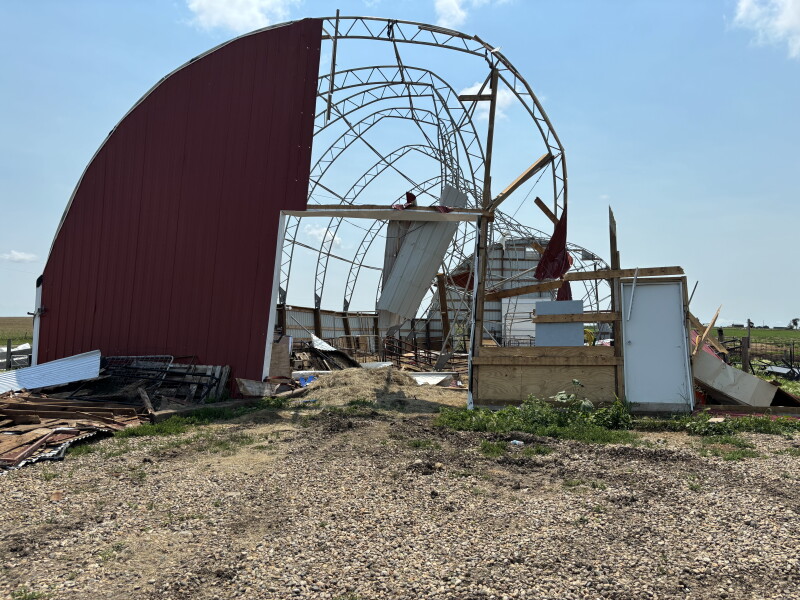
“We have one barn that we keep the goats in, and that’s the only one left standing,” Fletcher said. “It was just total devastation.”
“It’s pretty devastating to have most of it leveled to the ground,” Hanson said.
They also lost two doe goats.
“One had a severe broken leg, to the point where we couldn’t set it. So, we did have to put her down. She was a 3-year-old doe that was one of our very special does. She was a bottle baby back when she was a baby,” Fletcher said. “Then the other one, they found her under one of the walls of the hoop barn, and when they lifted it off of her, she had a broken back. Twenty other kids, weanlings, had gotten in with her and were under there, but they were OK, fortunately.”
She said even though they only lost a couple of goats, it was still very heartbreaking.
“I know a lot of other people who raise other types of livestock, cattle, sheep, can understand it. You know, you put your heart into it and your blood, sweat and tears, and to even just have a loss of two head is just heartbreaking,” Fletcher said.

Leveque lost part of his garage, some old graineries and a lot of fences for his livestock. Some of his neighbors lost large shops.
“I’ve seen the aftermath of a tornado, and it looked exactly like a tornado would have looked,” he said. “I don’t think we have many trees that weren’t in shelter belts that survived. So, there’s just a lot of cleanup.”
After the storm, Leveque flew his drone through Highmore, capturing video to share with people who were curious to see the damage without creating traffic through town during cleanup.
“You can see the damage was extensive,” he said.
With a lot of his fences gone, many of Leveque’s cattle were out and temporary fences needed to be built.
“We were in the process of working cows, and we didn’t get to all of them, and now, unfortunately, we had to put them all together in a couple of the yards that we had that sufficient fencing,” Leveque said.
He said it makes it harder to manage the herd when they aren’t separated like normal. Now that fences are down, he’s not sure where they will be able to finish working them.
“Where we normally do, we bring them in toward the house and yeah, those fences are just all completely gone,” Leveque said. “I’m still hoping we can find all the cows that got out. I’m sure we will eventually, but that’s another thing is, we couldn’t even get out to all of our fields to make sure, but I know we probably have some calves that have gotten in with the neighbors’ cows at this point. Then it’ll probably be a while before we get to work the rest that we needed to. It was already kind of late, but now it’s going to be even later.”
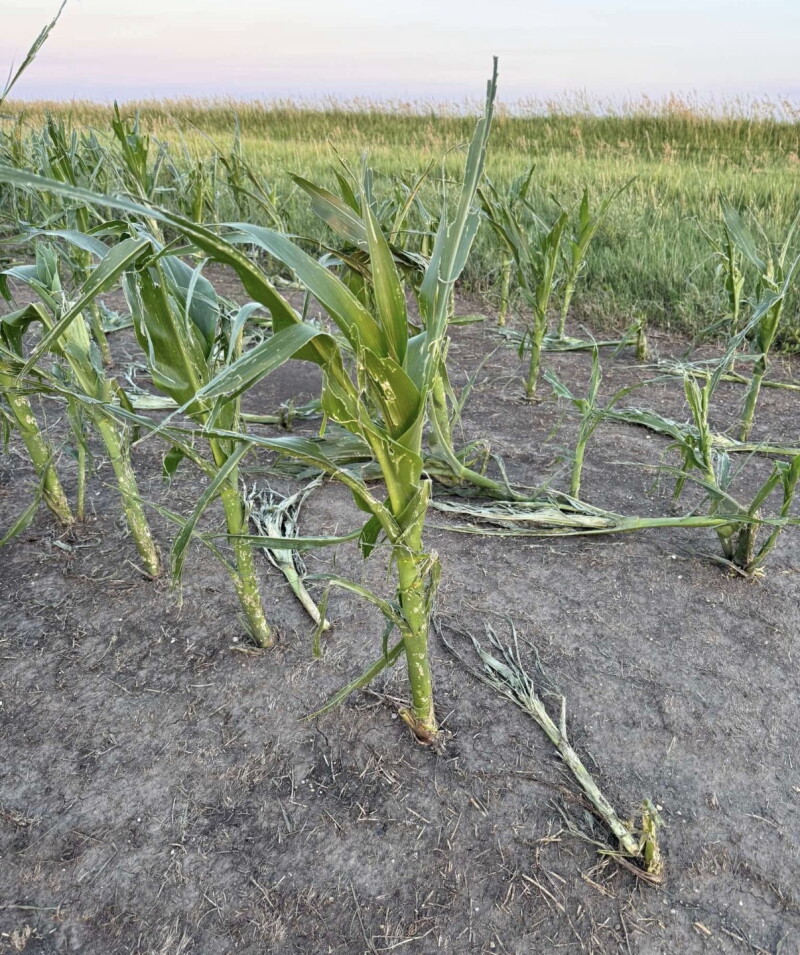
Karki said he also noticed a lot of damage to crop fields, even though he was just driving through. He said the storm pattern moved in a long distance, rather than wide, from southwest to northeast.
He said in crop fields, high wind damage could include crops lodging or green snap.
“The lodged crops have more chances to come back, especially in the earlier part of the season and, luckily for row crops, we are still in the early part of the season, so they still have chances to come back,” Karki said. “Depending on the damage and the defoliation, they can still go out and make a good grain crop.”
Small grains in the area are at a later growing stage. He said those probably sustained more damage.
“If they are flat on the ground, they’ll probably have more damage or impact on the yield per say than corn and soybeans at this point,” Karki said.
Shorter varieties of small grains may stand a better chance.
“If you have a shorter variety, you know, stronger strength, stronger stock strength, it can snap back and similar with the oats and spring wheat also,” Karki said.
Karki said it was probably the worst damage he had ever seen.
“In my own eyes, this is very, very bad,” he said.
Leveque said the hail damage mixed with the wind caused issues in the crops.
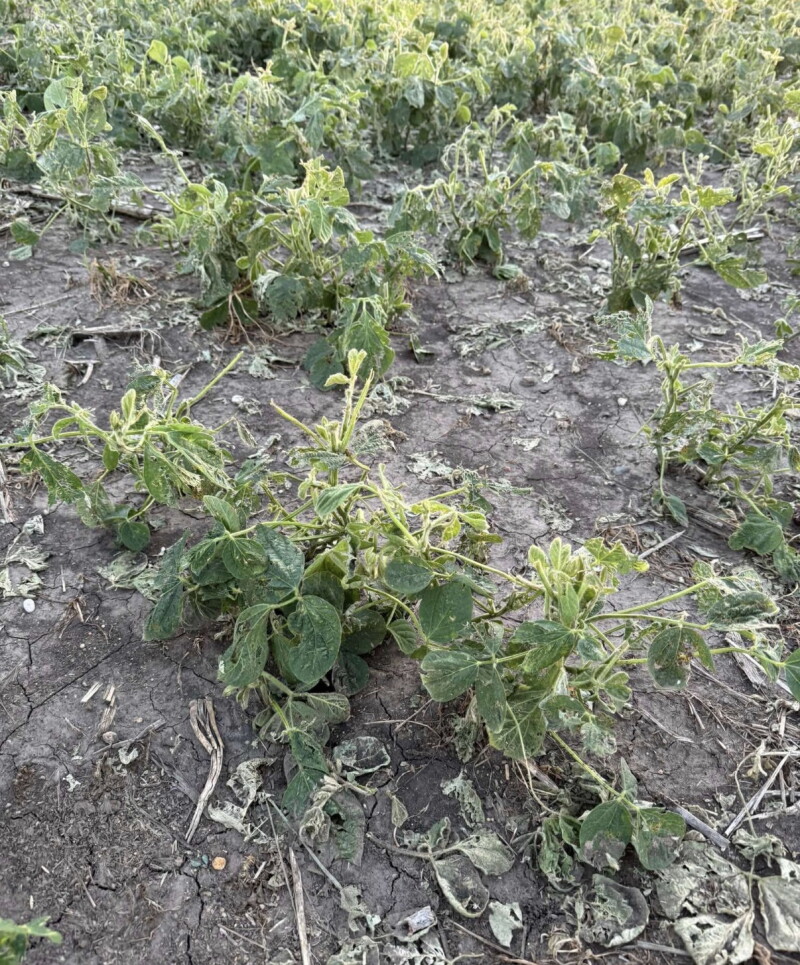
“Just leaves shredded, everything pushed down to the ground. You know, there was a few places where corn was probably a couple feet tall and that’s just all flatted and shredded. I mean, just a complete loss. It will be very interesting to see what the numbers come out to be, whatever they are,” he said. “But it’s is worse than I think I’ve seen in a very long time.”
Corn in the area is laying flat, Fletcher said, but some of it has been bouncing back.
“So we just keep on hoping for that,” she said.
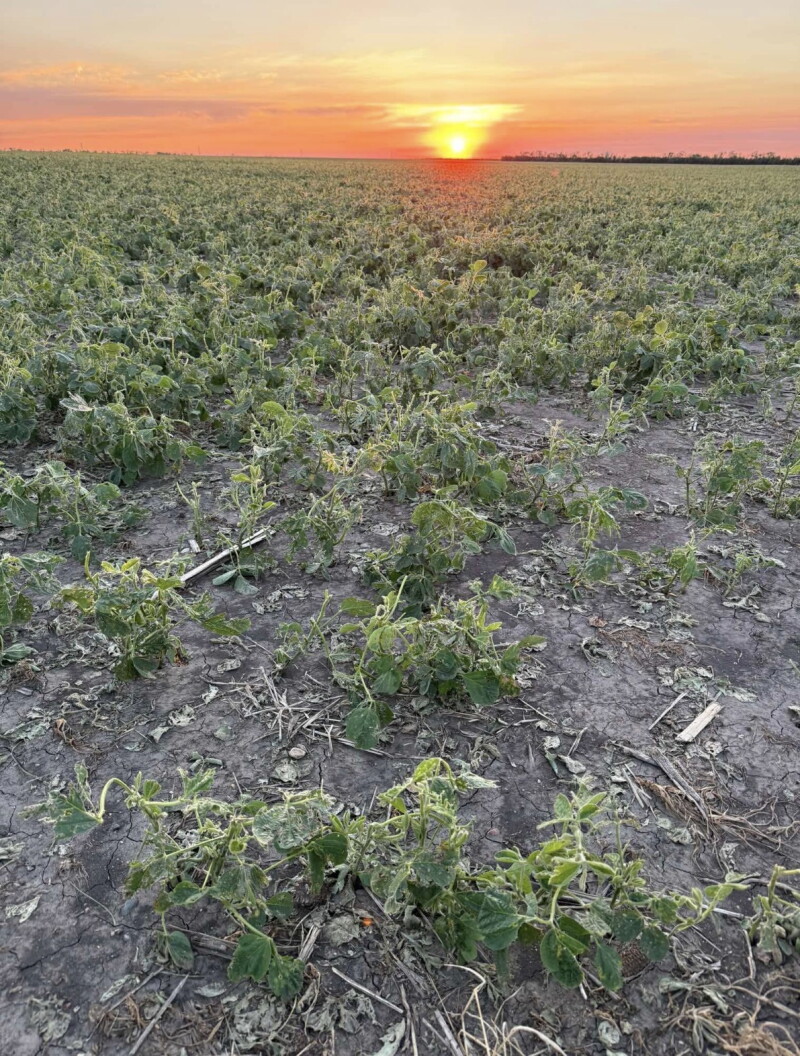
She said she was unsure of how the soybeans looked, but hopes that it’s early enough in the season for it to recover.
The road to recovery

Karki said the most important first step for producers is to assess the damage and talk with their insurance agent. Producers can also work with local extension agents and NRCS to help assess the damage in their fields and create a plan for dealing with the damage.
Damaged crops could see increased disease impact following the storm.
“One thing to keep in mind with hail damaged or high wind damaged crops, there’s another groups of microorganisms called bacteria, we all know bacteria, but we don’t think as much. They are an opportunistic organism and they like to have natural openings or infected openings, like you would with high winds or hail damage,” Karki said. “It can get into the plant and cause bacterial damages.”
If the crop is very damaged, there could be less traditional uses for it.
“If you have livestock, there are other opportunities to utilize that crop still, or go for a warm-season forage crop,” Karki said. “If you don’t have livestock, maybe your neighbor has, and you can have those alternative uses still from those fields.”
Karki also said, depending on the herbicides that have been used on the small grain fields, there are also options for producers to add cover crops to those fields.
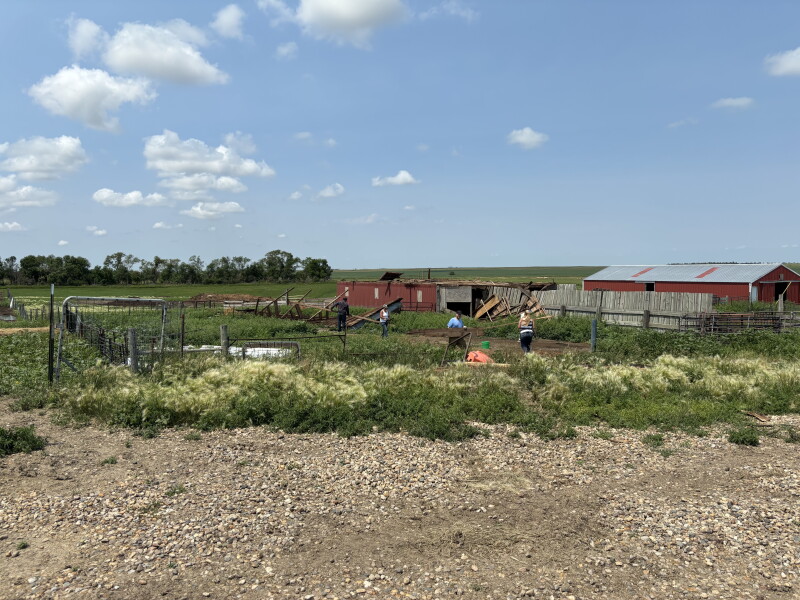
For Dakota Wind Meat Goats, rebuilding the infrastructure is going to be a long process. The first step was calling the insurance adjuster. They will wait on insurance before deciding what the rebuilding will look like.
“50-feet-by-108-feet is how big the barn was, so, you know, we had pens set up in there, gates, things like that, you know, to get it set up and everything so we could work our goats in there, having them in there for shelter, so it was devastating to have that loss,” Fletcher said.
“We have so many goats that we don’t have enough places to put them, you know, if it does rain or anything and goats don’t like rain,” Schultz said.
Leveque said he thinks the initial town cleanup should go fairly quickly, but it’s probably going to take a while to get all the buildings back up.
“It’s probably going to be months. I know for us, we don’t really have any buildings that we need to rebuild or any shops. We have other buildings that we can make do for now. For us, it’ll probably be months until we can get all the fences back up, and there’s only three or four of us out there that work on the ranch. So, it’ll be quite a while before we’re back 100%.”
Leveque said it has been nice seeing neighbors from surrounding areas coming out to help.
“It’s been awesome seeing everybody come together. Every farmer, I think, from the surrounding 50 miles has brought their loaders around and, you know, brought their tractors in to help clean up … Hyde County is probably 90% farmers, so just seeing them all come together and everything’s been really awesome,” he said.
The family at Dakota Meat Goats said it has been a blessing to get help from other communities.
“It just makes your heart swell. It’s very beautiful to see, you know, everybody coming together and working so hard. I mean, it’s awesome, it’s really awesome,” Schultz said.
“We feel so fortunate to live in a community where the surrounding community cities really come together,” Fletcher said.
“We have a really good church family. We have a lot of really good friends and relatives that will be coming out to help and it will take us quite a bit to clean it all up and decide what we need to do after that,” Hanson said.
]]>


